Building an Income Bucket: My Experience Investing in a Property Company
Most of us have savings buckets for retirement. Mine look like this:
- A retirement annuity to cover my personal expenses.
- A trust that owns my property and holds my long-term wealth.
- A company that handles my business-related expenses.
The problem is the company. When I stop working, it has no source of income. For the last few years I’ve been working on fixing that. The company now owns shares in three other businesses, but none of them are paying money back (yet).
Then I invested in a property company, and it changed how I think about the problem.
Counter-intuitive, but it pays
On paper, this investment goes against most of what I’d normally look for:
- It isn’t tax deductible. I’m buying a non-depreciating asset.
- It’s very cash intensive. Making the payments hurts.
But it’s returning money. That one fact opened my mind to a whole world of opportunities. Property is supposed to be “as safe as houses,” and even though it’s cash hungry, it can support my other goals. It has also introduced me to more like-minded people, which I value.
Where we invest
Johannesburg central is, to put it politely, a mess. Services are unreliable, the water supply is worse, and most investors won’t go near it.
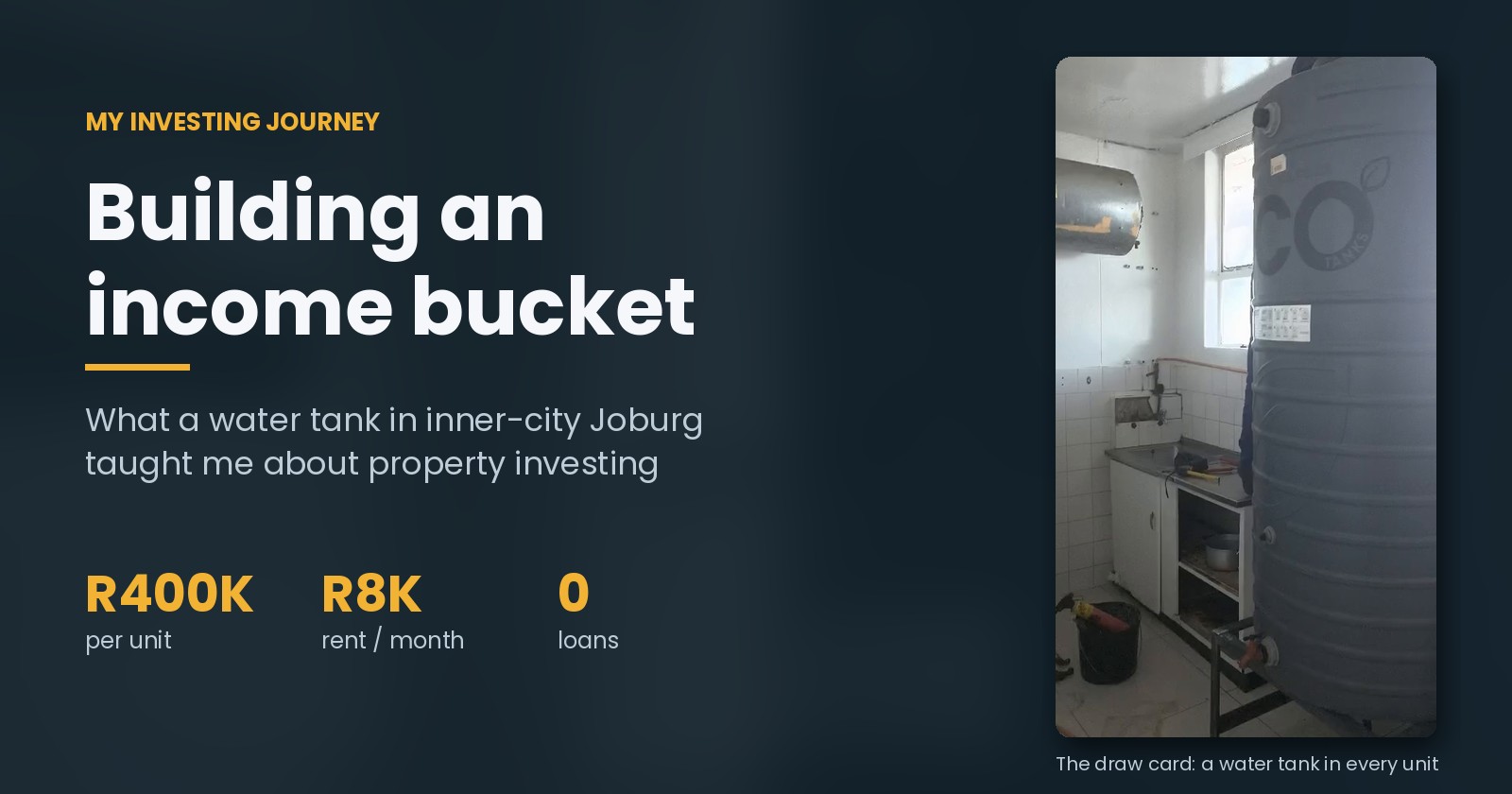
The company buys apartments in the inner city, mostly in one apartment block, for about R400,000 each including renovations. Once a three-bedroom unit is renovated, 6 to 8 people move in and it brings in roughly R8,000 a month.
One of our biggest draw cards is simple: we install a water tank in every unit. Joburg Water can’t supply water consistently, so a tenant who knows the taps will run is a tenant who stays.
A fun confession: I have no idea where these apartments actually are. I’ve never seen them in person. What I know comes from WhatsApp updates, photos and the occasional video of a water tank going in. That says something about how much the model relies on trust, and on the people running it.
How it’s structured
- 1,000 shares at R10,000 each. You invest in multiples of R10,000, and the full share capital could fund about 25 units.
- Cash only, no loans. Growth is slower, but there’s no bank breathing down our necks if a unit sits empty.
- An on-site property manager with skin in the game. He gets one share for every house we buy, so he’s rewarded for keeping the portfolio running and growing.
- The company pays no tax itself. Instead, each investor invoices the company for their share of the profit. The investor then declares it as income in whatever structure holds their shares, whether that’s an individual, a trust or a company. The tax is paid once, at the investor’s rate, not inside the company and then again on distribution.
- Investors. So far, about 20 with the director putting in the lions share. I don’t think it can grow much past 20.
Speak to your tax adviser about how this would work for your own structure before copying the model.
The people
The director communicates well, and he wants to systemise everything. The flip side is that he’s a bit sloppy on admin, because he believes it will all get done once the system is in place. At this stage the amounts are small, so I’m not stressed about it.
What I do like is that he’s learning in public. When our third unit (BP03) was fully funded, he shared this with the group:
“I learned a lot with BP03 from buying from auction. It’s not worthwhile if there is other stock. I tried auction for two reasons: to learn and see if it is better than normal stock – it is not. And it is good to buy these, as it is owners that don’t pay levies. The more owners that pay levies, the better the books will be. Together we will make the difference.”
That second point is easy to miss. Because we’re buying several units in the same block, the health of the body corporate is our health too. Every non-paying owner we replace strengthens the building’s finances. He has already spoken to the chairman about becoming a trustee of the body corporate, since he’s working on BP04 and owns four units of his own. For an investor, that’s the kind of alignment you want to see.
The first payout, and the questions it raised
My first income from the company got me excited about a new mindset: “You want a R200K car? Then buy R300K worth of houses and let the cash flow from the houses fund the purchase.”
When the group asked if shareholders had any questions, I posted these three:
Q1: What is the long-term goal?
We have 1,000 shares at R10,000 each. We’ve bought 4 houses at about R400K each, so about 160 shares have been issued. Is the plan to own roughly 25 houses in this price range? Or is there a bigger picture?
Q2: Can we commit to quarterly distributions, and can we buy faster?
The reports show about five months between buying a house and receiving rent, so the start-up was slow. Now it should start to snowball. My “houses fund the car” idea only works with at least quarterly distributions and the ability to buy more houses as cash comes in. Can we commit to quarterly payouts? And can we buy more than one house every four months?
Q3: Should we look at properties that pay for themselves from day one?
In theory, some properties cover their costs immediately, usually in more rural areas. They need someone nearby to keep an eye on things and some money in the bank for improvements that generate more income. Would the group want to explore this? If so, I’d have to change my thinking too. I shouldn’t count on a steady income stream if the business is reinvesting in longer-term projects.
My decision (for now)
For now, the decision is simple. I’ll contribute R400K to this company and enjoy a return of about R60K a year after costs (before tax in my own structure), or 15%.
What the group decides about the long-term vision doesn’t really change that. Neither does the possibility of starting another company with a different strategy. I have about 10 years of work left, and I’ll keep contributing to investments like this throughout that time.
I do have one rule: I’ll cap my exposure to Joburg central at R400K. “Safe as houses” is a nice saying, but I’m not convinced it fully applies to one apartment block in the inner city, especially one I’ve never seen. Concentration risk is real. Future money will go into different areas or different strategies.
In the meantime, I hope the non-property companies start generating cash too. If they do, my business will finally have what it’s been missing: income that doesn’t depend on me turning up for work.